Why your mini split makes noise in an Arkansas winter

Step 1 of 3: Equipment

Why does my mini split get so loud in winter?

Cold snaps bring that noise on fast. The unit sounds fine most of the year, then January hits and it's rattling, humming louder, or cycling on and off with a clunk each time. You want to know if that's normal for a mini split running through an Arkansas winter or if something's actually wrong with it.

It's working harder to pull heat from cold outdoor air, and that strains the parts that make noise

A mini split heats by pulling warmth out of the outdoor air, and the colder that air gets, the harder the compressor and the outdoor fan have to work to do it. That extra load is what you hear. The unit may also run a defrost cycle when ice builds up on the outdoor coil, and that brings a louder whoosh or a clunk as it reverses briefly to melt the frost off. Since most homes in Arkansas heat with electric systems like this one, a mini split working this hard on a cold morning is doing exactly what it's built to do. But a grinding, rattling or buzzing that wasn't there last winter is different. That points to a part wearing out, like a fan motor or a loose mount, and it's worth having someone who services this equipment take a look before it gets worse.

  1. Cold outdoor air hits the outdoor coil and frost starts forming on it.

  2. Frost buildup blocks airflow, so the system has to defrost itself.

  3. The reversing valve switches, sending hot refrigerant backward through the outdoor coil.

  4. That valve switch causes the whooshing or clunking sound you hear.

Is this just normal, or is something wrong

Listen for what's different from last winter. A clunk every time the defrost cycle kicks in is normal. A grinding or squealing sound is not. A unit that cycles on and off every few minutes instead of running steady is working harder than it should, and that shows up on your electric bill even with power as cheap as it is here. If the noise comes with weaker heat, or the indoor unit blowing cold air for a few minutes during defrost, check the room temperature against the thermostat setting. A mini split that's straining to keep up in an Arkansas cold snap can ice over badly enough to stop heating altogether, and if that happens on the coldest night of the year, you're left without backup heat until it's fixed.

A white wall-mounted mini-split air conditioner near the ceiling of a room with light gray walls, white crown molding, and a beige curtain at the left edge.

Running the way it should

This is what a healthy mini split looks like on the wall, quiet and doing its job. The sound you hear from this one is air moving and the occasional defrost clunk, nothing more. No rattle, no grinding, no cycling every few minutes.

A dusty beige wall-mounted mini-split air conditioner indoor unit installed high on a plain light-colored wall below the ceiling.

Signs it needs a look

Dust and grime built up like this on the housing usually means the filter hasn't been cleaned in a long time, and that staining on the wall points to condensate going somewhere it shouldn't. A unit in this shape is more likely to be the one rattling or clunking through January.

Normal Winter Noise or a Repair Call

Leave it alone

  • A clunk once every hour or so during a cold snap is the defrost cycle doing its job, not damage.
  • The unit runs louder on nights in the teens and 20s because it's working harder and defrosting more often.
  • If the noise matches what it did last winter and the mini split still heats the room, it's working as built.
  • A rattle that only shows up when wind hits the outdoor unit from one direction often is a loose panel or a bracket, not the compressor.
  • Short indoor fan noise at low speed on mild days is normal and goes away once the thermostat is satisfied.

Get it looked at

  • Grinding or squealing means metal on metal somewhere inside, and running it longer risks turning a repair into a replacement.
  • Cycling on and off every few minutes instead of running steady through a cold stretch points to a refrigerant or control problem.
  • A defrost clunk that's gotten noticeably louder or more frequent than last winter is worth having checked before it gets worse.
  • If the outdoor unit ices over and doesn't clear on its own, the defrost cycle itself may not be working right.
  • A local contractor who services mini splits all winter knows which of these sounds is the start of a bigger repair and which isn't.
  • Electricity is cheap here, but a unit short cycling or icing up still runs up the bill while it struggles to heat the room.
A gray-haired man in a dark sweater sits on a light gray sofa in a living room, looking toward a sunlit window with trees outside.
A gray-haired man in a dark blue sweater sits on a light gray sofa in a sunlit living room, looking off to the side, with a potted plant, shelving unit, and large glass doors behind him.
A bearded man with graying hair in a dark green sweater sits on a sofa in a living room, looking off to the side, with a sliding glass door and a dim kitchen doorway behind him.
A gray-haired man in a dark knit sweater sits on a light gray sofa in a living room, looking toward a sunlit window, with houseplants, a lamp, and framed art in the background.

Hand off the search today

Your request goes to one pro, not a list of companies.

No fee to send it, and nothing to sign.

A white wall-mounted mini-split air conditioner on a beige interior wall, with a curtained window on the left and wood flooring with a light rug below.

Working the way it should

This is what sits on your wall most of a normal winter. The casing stays clean, the vents are clear, and the sound is just moving air with an occasional clunk when it defrosts. A unit kept this way runs quieter through every cold snap.

A white wall-mounted mini-split air conditioner indoor unit installed near the ceiling on a plain light-colored wall, with its horizontal outlet vent and louvers visible.

Overdue for a look

Dust and discoloration like this build up over seasons, and they come with noise, not just a dingy casing. A coil caked in dust can't shed frost the way it should, so the unit works harder and runs louder every time it drops into the teens.

A middle-aged woman with shoulder-length dark hair, wearing a gray cardigan over a cream top, sits in an upholstered armchair and looks toward a sunlit window, with a shelf holding framed pictures and a plant behind her.
A woman with dark hair in a bun sits wrapped in a chunky knit blanket on a couch with a child resting his head on her shoulder, eyes closed, beside a lit lamp and bookshelf indoors.
A single-story red brick building with a hipped shingle roof and several white-framed windows, fronted by a large empty asphalt lot with sun flare, surrounded by green trees under a bright hazy sky.

Summers in Arkansas run humid, with a dew point averaging 68°F across June, July and August, according to NOAA. That's the moisture your mini split works against all summer, running long hours to pull it out of the air. That same strain shows up again come winter. Parts that spent the summer under heavy load are the ones most likely to run rough once temperatures drop and the unit shifts into frequent defrost cycles. A compressor or fan motor that worked hard in July is more likely to hum, rattle, or clunk harder in January. The noise you hear this winter often traces back to wear the summer humidity already started.

NASA POWER T2MDEW county cells weighted by homes

A dusty, discolored wall-mounted mini-split air conditioner indoor unit on a plain white wall, with its horizontal louvers and vent grille visible.
Before you get your mini split repair
A white wall-mounted mini-split air conditioner on a beige interior wall, next to a window with sheer white curtains and green foliage outside.
After you get your mini split repair

A mini split that keeps grinding or cycling every few minutes in a cold snap isn't just loud, it's working harder than it should and using more power to do it. Since most homes here heat with electricity, that shows up on the bill even though power in Arkansas is cheap. Left alone past one cold snap, a frozen coil that can't defrost properly forces the compressor to run longer each cycle, and a compressor that strains all winter is the expensive part to replace. The noise itself can travel through the wall it's mounted on, so a rattle you hear in the room is often worse than it sounds from outside. None of this means the unit is done. It means something inside it, the reversing valve, a fan motor, a sensor telling it when to defrost, isn't doing its job right. Catch it this winter and it's a repair. Ignore it through next winter too and you're choosing between a bigger repair and a new unit.

A white wall-mounted mini-split indoor unit installed high on a gray interior wall, with a sofa, dark table and window visible in an adjoining room to the right.
A mini split like this one is doing its job quietly, moving warm air into the room without drawing attention to itself.
A wall-mounted mini-split air conditioner indoor unit with a dusty beige casing and dark louvered vent, installed near the ceiling on a plain beige wall.
Dust and yellowing on the casing like this usually mean buildup inside too, and that's often what's driving the noise.
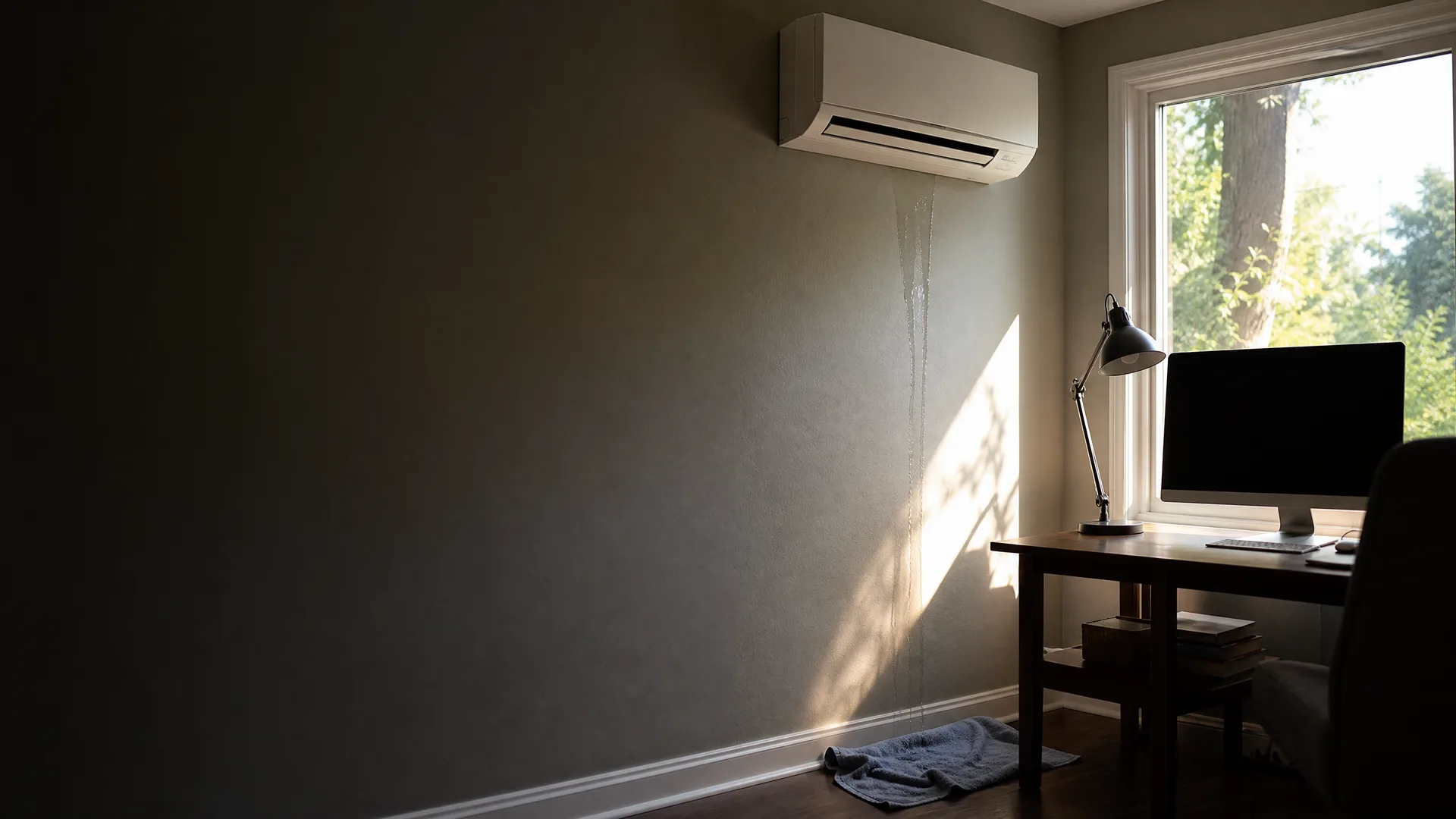
A wall-mounted mini-split air conditioner leaking water down a dim gray wall onto a towel on the floor, beside a window with a desk, lamp and monitor.

You're at your desk in the home office on a July afternoon, the mini split humming above the window behind you. You look up from the laptop because something's dripping. A wet streak runs down the wall under the indoor unit, soaking into the paint, and water has already pooled enough on the floor that you've thrown a towel down to catch it. The unit's still blowing cool air like nothing's wrong. Outside it's the kind of muggy Arkansas afternoon that keeps this thing running for hours at a stretch, and that's about all you can think looking at the stain spreading a little wider on the drywall.


Power costs 12.87 cents per kilowatt-hour statewide

At 12.87 cents a kilowatt-hour, running your mini split through a cold snap night after night doesn't hit your bill that hard. But a unit cycling or straining with a bad part still burns more than it should, and that adds up over a winter of cold nights.

EIA-861 2025 statewide residential average

What to do with that noise

  • A clunk every so often during a cold snap is the defrost cycle, not a fault.
  • Grinding, squealing, or cycling on and off every few minutes points to a real problem.
  • A unit matching what it did last winter needs nothing more than time and cold nights.
  • A local contractor who services mini splits all winter knows which sounds mean a bad part.
  • Sending one request puts the job with one licensed contractor instead of several competing for your call.
  • Catching a bad part now keeps a small fix from turning into a bigger one by spring.

A clunk now and then on a cold night is your mini split defrosting itself. That is the system working, not failing. Grinding, squealing, or short-cycling is different. That is a part wearing out, and it will not fix itself with warmer weather. The way to tell them apart is simple: does it sound like it did last winter? If yes, leave it alone. If no, it is worth getting looked at before the next cold snap makes it worse.

When it is time to call someone, who you get matters. A contractor who works on mini splits all winter in Arkansas has heard both sounds dozens of times and knows which parts tend to go first in weather like this. That is different from someone guessing at a noise they rarely hear. Sending one request connects you with one licensed, local contractor, not a handful of companies bidding for the job. You get someone who already knows what a mini split goes through on a night in the teens, and who can tell a defrost clunk from a real problem without having to think twice about it.

None of this is urgent in the way a dripping pipe is. But a bad part left alone through a long winter tends to work harder, draw more power, and fail at a worse time than this one. Getting it checked now is the easier path.

Kitchen corner with cream upper cabinets, oak lower cabinets, white marble-look countertop, beige tile backsplash, a ceramic vase of greenery, a wooden cutting board and bowl, and a black-framed window at right.
Interior corner of a room with a white-framed window and wide sill, beige walls with panel molding, a wooden cabinet holding a ceramic vase with a green leafy plant, and blurred shrubs and trees outside.
A wood-framed armchair with beige cushions and a woven lumbar pillow sits in a corner beside a large window overlooking green trees, with a tall ceramic vase holding leafy branches on the left and plaster walls and wood flooring.
Interior corner with a white-framed window above a sill, beige walls with baseboard molding, a greige shaker-style cabinet with brass knobs and a potted plant on top, light wood flooring and a woven jute rug.
A dark-framed six-pane window with white trim and sill set in gray horizontal lap siding, with hydrangea shrubs below and a white column and shingled roof section at left.

Hand off the mini split problem

The pro who reaches out is licensed in Arkansas.

Find a local pro

Sending the form costs nothing.