

Why your mini split leaks water in an Arkansas winter

Step 1 of 3: Equipment

A mini split leaks water in winter because it's running as a heat pump and pulling moisture out of the outdoor air. That moisture condenses on the cold outdoor coil, and the unit is built to drain it off through a small condensate line. When that line is cracked, clogged, or frozen shut, the water backs up and drips out where you can see it instead of where it should go. Cold snaps make this worse. If the outdoor coil ices over, the ice melts during the defrost cycle and the drain has to handle more water than usual, right when it's most likely to be partly frozen itself. A leak isn't something to leave alone. Water finds its way into the wall, the floor, or the unit's own electronics, and a clogged drain now is a frozen, split line later. Caught early, it's a simple fix.

A white wall-mounted mini-split air conditioner unit installed high on a light gray interior wall below crown molding, with a bamboo-shaded window at the lower left.

Draining the way it should

The indoor coil stays dry to the touch and the drain line runs clear to the outside. You might notice a faint drip outdoors when the unit first kicks on in defrost, then nothing. No staining under the indoor head, no pooling on the floor below it.

A wall-mounted mini-split air conditioner indoor unit with a dusty, discolored cover, installed near the ceiling on a plain light-colored wall.

Water finding another way out

Water shows up on the wall under the indoor unit, or drips steadily onto the floor. The casing may look dusty or discolored where moisture has been sitting against it. Ice can build on the outdoor coil too, melting into a puddle once the unit cycles off.

Where the water is coming from

Clogged or frozen drain line

  • Algae and dust build up inside the drain line over months and narrow the path water has to take to get outside.
  • Once that line clogs, condensate backs up into the drain pan and spills over onto the indoor head or the wall behind it.
  • If the outdoor coil ices over during a hard freeze, the drain line can freeze solid too, and meltwater has nowhere to go but back inside.
  • A drain line that was never pitched correctly toward the outside will pool water at the low point no matter how clean it is.
  • Water stains spreading across the ceiling or wall under the indoor unit usually mean this is already happening.

Problem elsewhere in the system

  • A dirty air filter restricts airflow across the indoor coil, and the coil can get cold enough to frost over and then drip when it thaws.
  • Low refrigerant charge drops the coil temperature below normal, which also causes icing and dripping instead of a clean condensate drain.
  • A cracked or disconnected drain pan lets water escape before it ever reaches the line meant to carry it outside.
  • The defrost cycle that melts ice off the outdoor coil can overwhelm a line that's already partly blocked, pushing water back toward the indoor unit.
  • If the unit was installed without enough slope on the line or without a proper vent, water sits instead of draining and finds another way out.
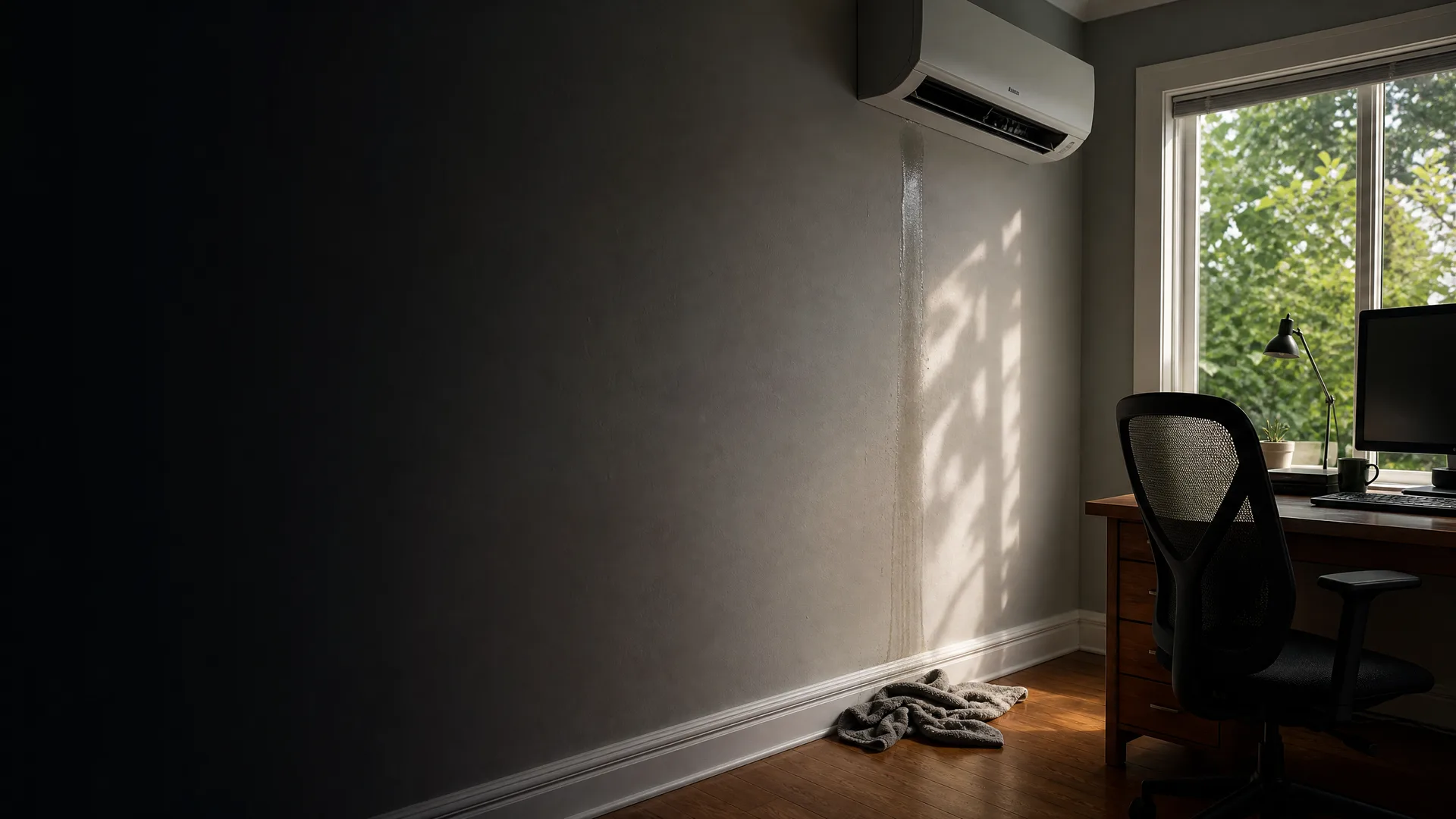
A wall-mounted mini-split air conditioner in a dim room, with a water streak running down the wall below it to a towel on the floor near the baseboard, beside a desk, office chair and monitor by a window.

You're at the desk in the home office, working through the afternoon, when you notice the wall under the mini split looks dark. You get up and there's a wet streak running down from the indoor unit, soaking into the drywall. You grab a towel off the hall closet and press it against the baseboard, then step back and look at the unit itself, trying to figure out where the water is coming from. The room is warm, the rest of the house is fine, it's just this one wall. You leave the towel on the floor under it and go find your phone.

One request and it's handed off

A clogged or frozen drain line doesn't clear itself. Left alone, it keeps backing up every time the unit runs, and the water finds a new path each time, down the wall, under the flooring, into whatever is behind that drywall. You could spend an afternoon on the phone finding someone licensed to work on a mini split, then another explaining what you're seeing, then wait on quotes to see who's worth calling back. Or you can send this request once and let someone qualified take it from here. Arkansas winters don't stop the system from running, and the unit won't stop pulling moisture from that outdoor coil just because the line is blocked. The longer it drains where it shouldn't, the more there is to repair besides the line itself. Get the request in and stop carrying this one alone.

Why defrost cycles make it worse

When the outdoor coil gets cold enough, the unit stops heating for a few minutes and runs a defrost cycle to melt the frost built up on it. That melted frost has to go somewhere, and it's more water than the coil sheds the rest of the time. A drain line that's been handling light condensate fine can still choke on that extra load, especially if it's already narrowed with algae or dust. That's why a leak often shows up first on the coldest days, right after the unit cycles through defrost, rather than during a mild stretch.

What the outdoor half is doing

The indoor head is only half the system. The outdoor unit has its own coil and its own job in winter, pulling heat out of air that feels too cold to have any. Arkansas winters swing enough that the outdoor coil can frost over one week and stay clear the next, so the drain line's workload isn't steady. A line that drained fine in November can struggle in January once nighttime temperatures drop far enough to trigger defrost more often. The fix is the same either way: clear the path water takes to get outside.

A smiling man in a gray long-sleeved shirt stands in a kitchen looking to the side, with open shelves of dishes, a white mug on the counter, a potted plant, and a view through a doorway into a living room.
A smiling bearded man in a green sweater sits at a white marble kitchen island with a mug, potted plant and bowl of fruit, in a bright white interior with open shelving and an arched doorway.
A smiling man with dark curly hair and a beard, wearing a dark green knit sweater, stands at a white marble kitchen counter with a dark blue mug, with open shelving, pendant lights and a houseplant behind him.
A smiling man in a green ribbed sweater stands behind a wooden table holding a ceramic mug of coffee in a kitchen with white subway tile, shelves of potted plants, and a bowl of fruit.

Fix the drain line now

A contractor clears the clog or thaws the line and checks the slope and the pan. The leak stops that day, before it reaches the subfloor or the room below.

Start one form

Keep setting out towels

The line stays blocked and backs up again the next time the unit runs. Drywall, flooring and whatever's behind that wall keep soaking up water you can't see.

Start one form

Is that water stain under your mini split getting bigger

Look at the wall below the indoor head. A dark patch that wasn't there last week, or a line creeping lower each time the unit runs, means the drain is backing up somewhere behind it. Feel along the bottom of the unit itself. If it's damp or dripping from underneath rather than just at the outdoor line, the pan inside has already overflowed once. Check the floor too, especially if the unit sits on an upper level, since water tracks down into the ceiling or flooring below before it ever shows up on a wall you can see. Left alone, that moisture sits in drywall and subfloor and doesn't dry out on its own.

A wall-mounted mini-split air conditioner indoor unit with a dusty off-white casing and dark lower vent, installed high on a plain light-colored wall below a ceiling molding.
Before you get your mini split repair
A white wall-mounted mini-split air conditioner installed high on a beige interior wall below crown molding, with a window and light curtain on a black rod at right.
After you get your mini split repair

Power costs 12.87 cents per kilowatt-hour statewide

At 12.87 cents a kilowatt-hour, running your mini split as a heat pump all winter still costs less than baseboard or a furnace would. That's worth protecting. A clogged drain line left alone can mean drywall and flooring repairs on top of whatever you already pay to heat the house.

EIA-861 2025 statewide residential average

A smiling man with dark curly hair in a navy t-shirt sits on a gray couch indoors, with a large-leafed plant and a window in the background.
A bearded man in a plaid flannel shirt stands in a kitchen looking out a window toward snow-covered shrubs, with a steaming mug on the windowsill and potted plants on a shelf behind him.
A closed dark laptop and a ceramic mug of coffee on a wooden dining table, with wooden chairs, a dark kitchen cabinet with cutting boards and a potted plant, and a leafy plant by a window in the background.

Your mini split shouldn't be leaking water

A clogged or frozen drain line is why water is coming out from under your indoor head this winter. The unit is doing its job, pulling moisture out of the outdoor air and shedding meltwater during defrost. The line is supposed to carry that water outside. Once it's blocked, the water has nowhere to go but down your wall.

A contractor can clear or thaw that line, check the slope and the pan, and have it draining the way it's supposed to again. That's one call instead of searching through contractors, explaining the wet wall over the phone to each one, and sorting through quotes before anyone shows up. Send the form and that part is off your plate.

A living room corner with a beige sofa and cushion, a round wooden coffee table holding a pale ceramic vase of eucalyptus stems and a wooden bowl, and a curtained window with a potted plant above a latticed radiator cover in the background.
A dark wood cabinet with a paneled door and a ceramic pot of green foliage on top stands in a beige-walled room with white baseboard, a window at left, hardwood floor, and a patterned area rug.
A dark wood glass-front cabinet holding folded towels, woven baskets and a ceramic vase stands in a bathroom corner beside a window, with a potted fern and stacked towels on top and a freestanding tub partly visible at left.
A woven basket holding a green cushion and a cream fringed knit throw sits on a wood floor in a room corner beside a window and a dark wooden cabinet.
Corner of a room with a dark wood cabinet topped by a round vase, a linen curtain at a window, white baseboard, oak plank flooring with sunlight patches, and a woven jute rug in the foreground.
A dark wood sideboard against a pale wall holds a shallow stone bowl and a round ceramic vase with leafy branches, with sunlight from a curtained window falling across the wall, wood floor and woven rug.

It's off your list after this

Fill out one short form instead of calling around.

Skip calling around

You're not committing to anything by asking.














