Tell us about the job
Takes about a minute. No obligation.
A mini-split compressor in Cleburne County starts and stops on every warm day from June through September, and that cycling is where the wear adds up. Homes in Cleburne County, AR run cooling about four months a year, from June through September. The contactor closes and opens with each compressor cycle, and after enough seasons it pits or welds partly shut, which throws extra load back onto the compressor itself. A contractor diagnosing a refrigerant or electrical fault here checks the contactor and the compressor terminals before pricing anything else, because those are the parts that take the heat.
Half the homes in Cleburne County, Arkansas were built in 1989 or earlier (2020-2024 ACS 5-year). A mini-split does not run in isolation from the structure it was installed into, and in housing stock of this vintage, the line sets, condensate drainage, and wall penetrations a previous installer chose were fit around interiors that were never designed for ductless equipment. When a contractor opens a unit for repair, what they find inside can be clean or corroded, but what they have to trace back through the wall decides how the repair is scoped. A refrigerant leak or a drainage fault that looks like a simple fix can sit at a junction where the line set bends around original framing, and accessing it means working with what the house already has rather than what would have been specified from scratch.
The Parts of a Mini-split a Contractor Checks During Repair
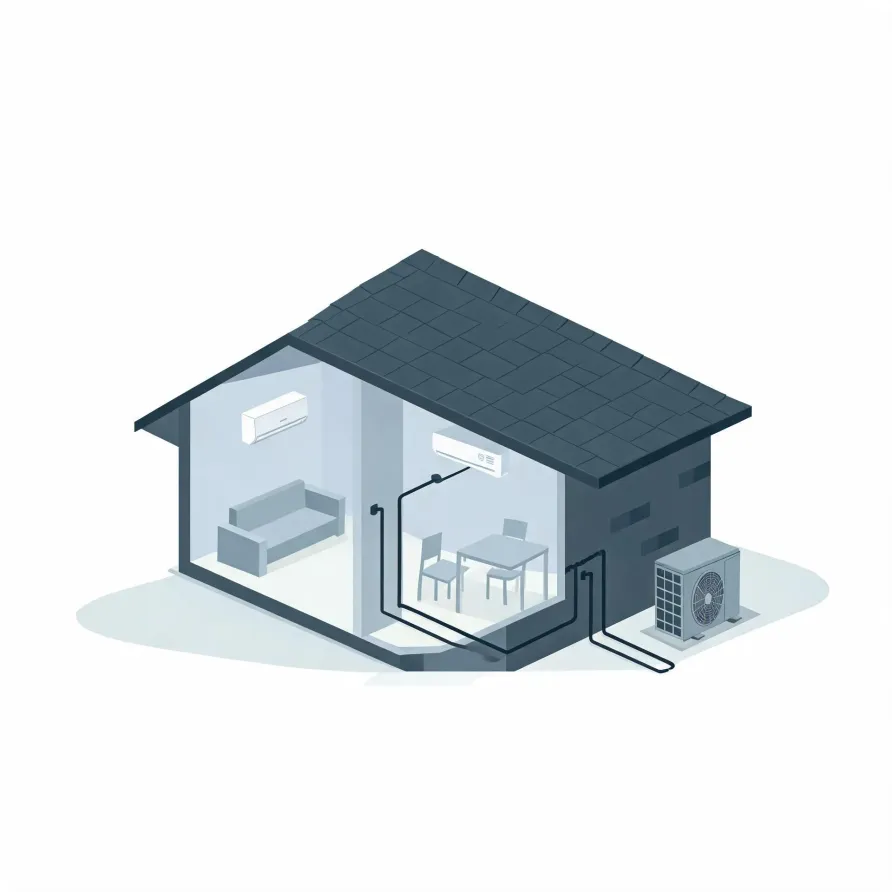
The indoor air handler mounts high on an interior wall and is the piece most homeowners notice first. It pulls room air across a coil and a blower fan, and when something inside it fails, the result is weak airflow, ice on the coil, or air that never reaches the set temperature. The outdoor condenser unit sits on a pad or bracket outside and holds the compressor, which is the component a contractor will want to rule out early.
A refrigerant line set runs between the two units through a small opening in the wall, carrying the charge that makes the system work. Alongside it runs a condensate drain line from the indoor unit, which clogs quietly and causes water damage or triggers a shutdown before most homeowners suspect it. Each of these connections is a place a contractor checks when the symptom points to the system not performing as it should.
The drawing shows a typical mini-split layout, and a licensed contractor determines which parts apply and what work is needed in your specific home.
Find a contractor in Cleburne CountyCleburne County by the Numbers
47 severe weather events were recorded in Cleburne County, Arkansas between 2015 and 2024.
NOAA National Centers for Environmental Information, Storm Events Database, bulk CSV export, events 2015-01-01 through 2024-12-31.Half the homes in Cleburne County, Arkansas were built in 1989 or earlier (2020-2024 ACS 5-year).
U.S. Census Bureau, 2020-2024 American Community Survey 5-Year EstimatesCleburne County, Arkansas holds 15,667 housing units (2020-2024 ACS 5-year).
U.S. Census Bureau, 2020-2024 American Community Survey 5-Year EstimatesOwners occupy 80.6% of the occupied homes in Cleburne County, Arkansas (2020-2024 ACS 5-year).
U.S. Census Bureau, 2020-2024 American Community Survey 5-Year EstimatesCodes & Standards Behind Mini-Split Repair in Cleburne County, Arkansas2 sourced rules
Licensing Rules for Contractors in Cleburne County, Arkansas
An Arkansas HVACR licence is good across the state: no city or county may require its own licence to do HVACR work, though local permits and inspections still apply.
Arkansas requires an HVACR licence or registration: it is unlawful to do HVACR work without the appropriate one unless the chapter exempts you.
Severe Weather Events in Cleburne County, Year by Year
Arkansas weather puts real demands on heating and cooling equipment, and what happens in Cleburne County shapes how hard local systems have to work and how often they need attention. Repair needs here are tied to local conditions, which is why the record below is part of the picture.
47 severe weather events, 2015–2024. Source: NOAA National Centers for Environmental Information, Storm Events Database.